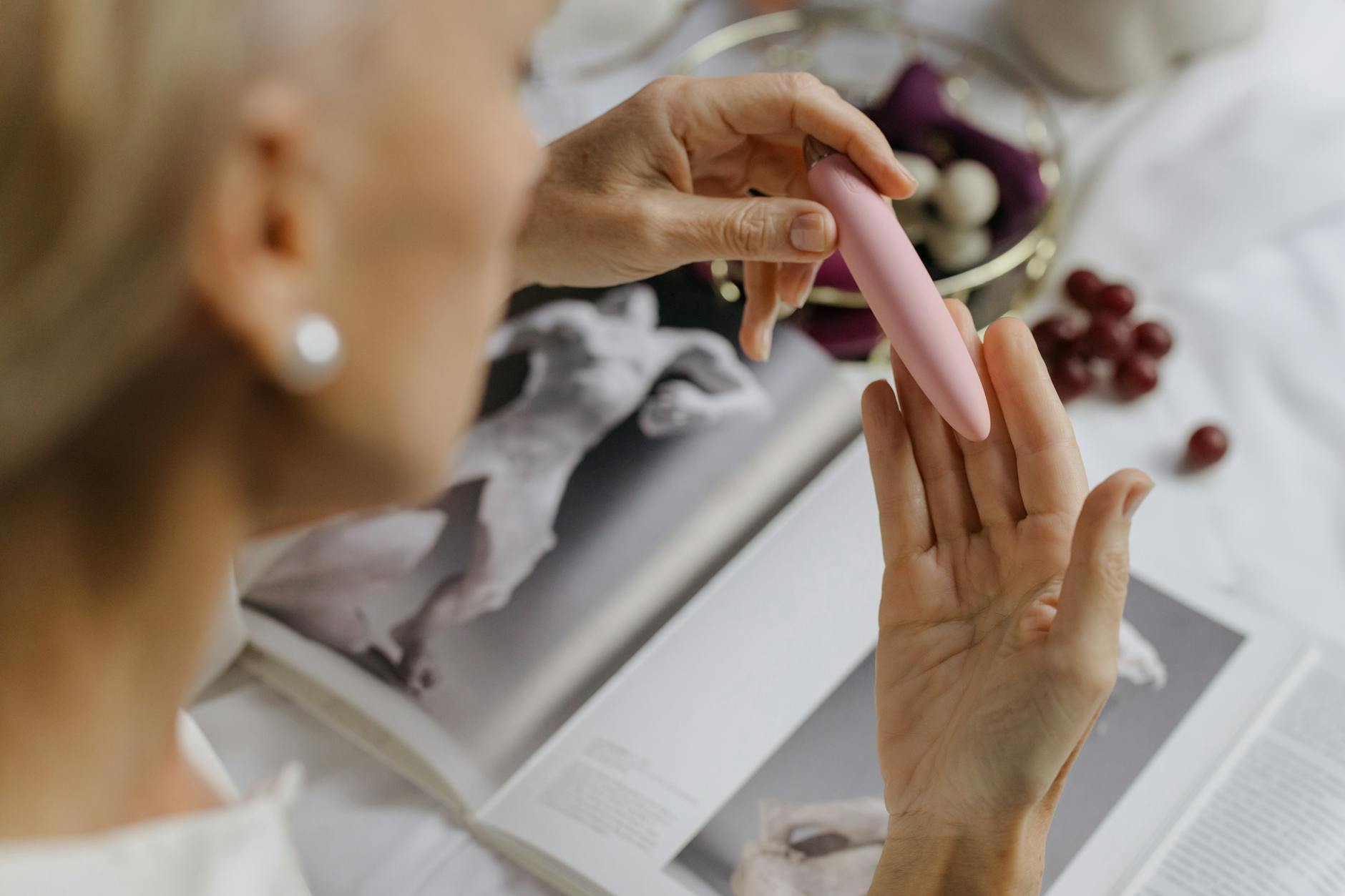
Let's talk about the numbness nobody wants to admit
You've had sex, or masturbated, or both, for years. Decades, maybe. And somewhere along the way, your clitoris stopped talking back.
It's not that sensation disappeared entirely. It's that the intensity required to feel anything meaningful keeps climbing. What used to work doesn't. What works now barely registers. And the whole thing starts to feel like you're chasing a dimmer switch that keeps turning down.
Here's what I tell people in my practice: clitoral numbness is real, it's fixable, and it often has nothing to do with being broken.
Why years of the same stimulation flatten sensation
Your clitoris has about 8,000 nerve endings crammed into a space the size of a pea. That's the hardware. But sensation isn't just hardware. It's a relationship between nerves and your brain's attention.
When you use the same toy, the same pattern, the same pressure for years, your nervous system gets efficient at ignoring it. This is called sensory adaptation. It's the same mechanism that lets you stop noticing background noise or the weight of your clothes.
Repetitive friction stimulation is particularly prone to this because it produces a predictable, constant signal. Your brain learns the rhythm, predicts what's coming next, and essentially turns the volume down. Over time, you need more intensity to break through the adaptation. But more intensity doesn't fix the underlying problem. It just adds friction to a system that's already fatigued.
Lemon clitoral vibrators work differently because suction is a completely different signal. It's not friction. It's rhythmic pressure that mimics the actual physiological sensation of arousal (your clitoris engorges and fills with blood, which creates a similar suction-like sensation internally). Your nervous system perceives this as novel. And novelty is the fastest way to wake up adaptation.
How suction patterns reset sensory fatigue
Lemon vibrators use air-pulse technology that creates patterns of suction rather than vibration. This matters because of how your sensory neurons fire.
When you use a traditional vibrator, your nerve endings receive a constant high-frequency signal (80, 100, or sometimes 200+ vibrations per second). Your brain quickly adapts to predictable frequencies. It's like listening to white noise. After a while, you stop hearing it.
Suction creates an intermittent pressure pattern that varies. Even on a single setting, the sensation feels different across the tissue because of how the air seal interacts with different areas of the vulva. Your nervous system can't tune this out the same way it does vibration.
Most importantly, lemon vibrators let you start low. The gentlest setting on a lemon sucker feels like a whisper compared to the lowest setting on most wand vibrators. This is crucial when you're rebuilding sensation because it means you can finally experience subtle arousal signals again.
When people with numbness switch from wand vibrators to lemon clitoral vibrators, the most common report is: "I can feel things I haven't felt in years." That's not magic. That's sensory recovery.
The rewiring process: three phases you'll notice
The first two weeks feel weird. You might notice sensations that seem almost wrong. Tingling in places that usually feel numb. Sensitivity that makes you want to pull away. This is your nervous system waking up, and it can be uncomfortable.
Stay with it. Use the lowest settings. Take longer breaks. Your nervous system needs to remember how to receive without bracing.
Weeks three through eight, things settle. Sensation becomes more nuanced. You might notice that different settings feel genuinely different now, instead of all being variations on "too numb to care." You might also notice your arousal building more slowly but more deeply. This is normal. You're rebuilding the signal chain from your clitoris to your brain.
After eight weeks or so, most people report that their baseline sensitivity has shifted. They need less intensity to feel pleasure. Orgasms, when they come, feel different. Often more localized or more diffuse, depending on the person. The important part: they're coming again, and they feel intentional instead of obligatory.
What actually works during the rewiring phase
Four things I recommend to almost everyone rebuilding after numbness:
Start with the lemon's lowest setting. Not setting two. Not even mid-range. The very gentlest. Your job is to reintroduce sensation, not to chase an orgasm. Orgasms will come back, but only after sensation does.
Use for shorter sessions, more often. Instead of a 20-minute "I'm trying to come" session, do five-minute explorations. Pay attention to what you actually feel. Where do you feel it? What does it remind you of? This is retraining your attention, which is half of sensation recovery.
Introduce variety in the other settings gradually. Once the lowest setting starts feeling familiar again, spend a week on the next level up. Then the next. You're not chasing stimulation. You're mapping your own responses again.
Partner with patience, not pressure. If you're with someone, tell them what's happening. Clitoral numbness often gets tangled up with performance anxiety (they're worried you're not enjoying it, you're worried you can't perform, and suddenly it's not about pleasure at all). <a href="/blog/lemon-vibrator-couples-therapy-rebuilding-intimacy-without-pressure">Lemon vibrators help couples rebuild intimacy without performance pressure</a> partly because the toy is doing the stimulation work, not your partner. There's nothing to prove. Just sensation to recover.
Why you don't need to keep using the same toy that caused the numbness
This is the part people get stuck on. They think: "I've been using a wand vibrator for ten years. That's just my baseline. I can't change it."
You can. In fact, changing it is essential.
Keeping the same tool after you've adapted to it is like trying to rebuild strength in your muscles by lifting the same weight you're already adapted to. You need novelty. You need a different stimulus pattern to force your nervous system to pay attention again.
Lemon clitoral vibrators offer that pattern shift. The suction sensation is genuinely different enough from friction that your nervous system treats it as new information. And new information is how you break adaptation.
After you've rebuilt baseline sensation with a lemon vibrator, you might decide to go back to wands sometimes. That's fine. But you'll likely notice you need them less intensely now. Your nervous system has learned how to receive again.
The role of stress and attention in clitoral numbness
Here's a part that often gets overlooked: numbness isn't always about the toy. Sometimes it's about everything else.
Stress, anxiety, distraction, and relationship disconnection all flatten arousal. Your clitoris needs your brain's attention to register sensation fully. If you're worried about work, thinking about whether you're taking too long, or feeling disconnected from your partner, your nervous system prioritizes threat over pleasure. Sensation gets muted.
Lemon vibrators help here too, but in a different way. The suction sensation is so distinct that it hijacks attention in a good way. It's harder to think about emails or bills or whether you're "performing" correctly when something is actively engaging your nervous system in a novel way.
<a href="/blog/how-lemon-vibrators-improve-sensation-with-cortisol-and-stress-response">How lemon vibrators improve sensation when stress blocks pleasure</a> is a deeper dive into this, but the short version: if stress is contributing to your numbness, the novelty and attention-capturing nature of suction stimulation can help your nervous system downshift into pleasure mode.
When to check in with a specialist
If numbness is paired with pain, or if it came on suddenly instead of gradually, talk to a gynecologist. Sudden clitoral numbness can signal nerve issues that need medical attention.
If you've been experiencing numbness for years and it's never improved with toy changes or stress reduction, a pelvic floor physical therapist can help assess whether tension or scar tissue is part of the picture. Sometimes rebuilding sensation also means gentle release work on the pelvic floor.
But if your numbness is the slow fade of adapted sensation, the kind that crept up over years of the same stimulation pattern. Lemon vibrators genuinely can rewake you.
FAQ
Why does clitoral numbness happen with vibrators specifically?
Vibrators produce a high-frequency, predictable signal that your nervous system adapts to faster than other forms of stimulation. The more consistently you use the same vibrator at the same intensity, the more your brain learns to filter out that signal. It's not a character flaw. It's how human neurology works.
How long does it take to feel sensation again after numbness?
Most people notice subtle changes within two weeks of switching to a different stimulus pattern like suction. Noticeable improvement usually shows up by week four or five. Full sensation recovery typically takes eight to twelve weeks. Everyone's timeline is different depending on how long the numbness lasted.
Can I use lemon vibrators if I'm not experiencing numbness?
Absolutely. Lemon clitoral vibrators are designed for anyone, not just people recovering from adaptation. Many people prefer them from the start because the suction sensation feels more natural and because the lowest settings are genuinely gentler than most traditional vibrators. <a href="/blog/why-lemon-vibrators-work-better-than-traditional-vibrators-for-first-time-users">Why lemon vibrators work better than traditional vibrators for first-time users</a> covers this in detail.
Is numbness reversible, or is it permanent once it starts?
It's completely reversible. Your nervous system isn't broken. It's adapted. And adaptation can be undone. The key is introducing a genuinely different stimulus that your brain can't automatically filter out.
What if I switch to a lemon vibrator and still don't feel anything?
Give it time. Two to three weeks minimum. Your nervous system has spent years ignoring signals, and it takes a little while to remember how to receive. If after four weeks you're still not feeling any shift, check in with a pelvic floor physical therapist. Sometimes tension or scar tissue needs release work alongside sensation retraining.
Can numbness come back if I go back to my old vibrator?
Yes, it can. But it usually comes back more slowly the second time around. Once you've experienced the difference, you're more aware of when adaptation is starting. You can change things up earlier. The goal isn't to never use traditional vibrators again. It's to stay varied enough that your nervous system never fully adapts.
Clitoral numbness feels permanent when you're in it. But sensation is recoverable. Your nervous system is built to adapt, which means it's also built to reset. Lemon vibrators work because they're different enough to break that adaptation cycle and let you feel arousal again the way you did when pleasure was still new.
If you want to explore how your body responds to different stimulus patterns, or you're not sure where to start with sensation recovery, <a href="/contact">reach out</a>. I'm here to help.